High-Functioning Anxiety: When You Look Fine But Don't Feel Fine
Deadlines met early, messages answered in minutes, and a stomach that hasn't unclenched in weeks. Why anxiety that produces results is the hardest kind to name, and what actually helps.
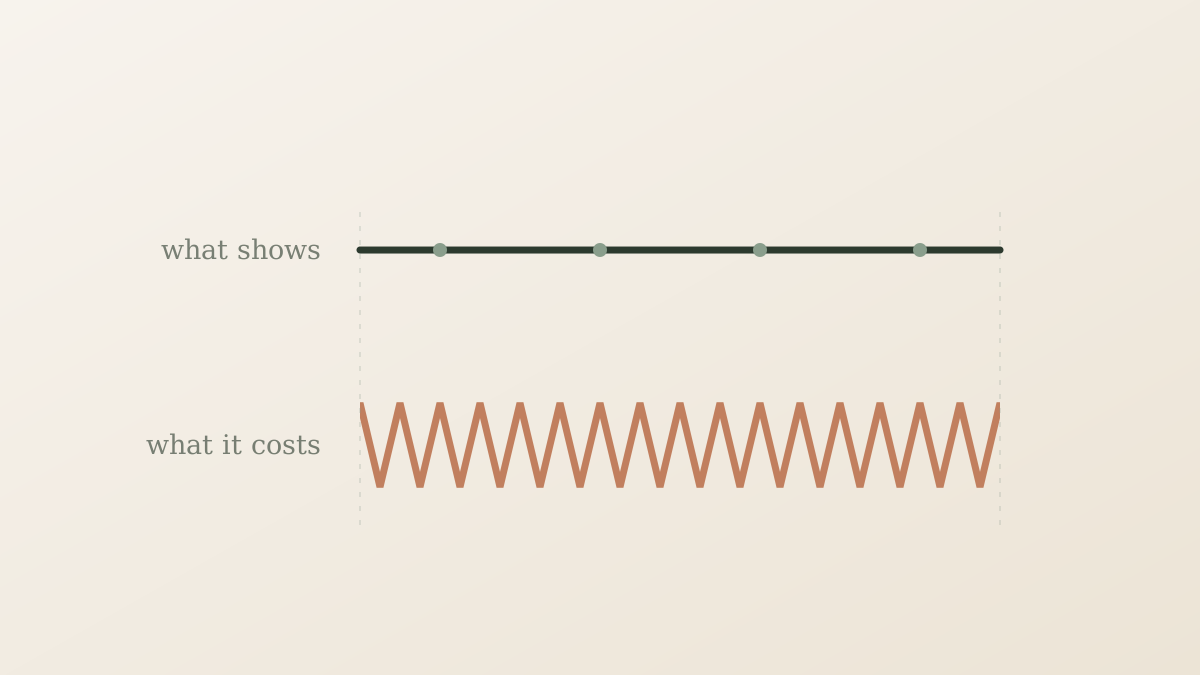
You're the one who submits everything early. Who replies to messages within minutes. Who's described as "so put together" by people who have no idea that getting there involved three redone drafts, a stomach that hasn't fully unclenched in weeks, and a to-do list that never quite feels complete even when it's finished.
From the outside, it looks like things are going well. From the inside, it can feel like running a background process that never shuts off, one that happens to also be very good at producing results, which is exactly why it goes unnoticed for so long, sometimes by the person experiencing it most of all.
This is often what people mean by high-functioning anxiety. It isn't a formal diagnosis, you won't find it in a diagnostic manual, but it's a genuinely useful way to describe a pattern that a lot of people recognise and very few talk about, mostly because it doesn't look like what anxiety is "supposed" to look like.
Why it's easy to miss
Most descriptions of anxiety focus on visible struggle: falling behind, avoiding things, being unable to function. High-functioning anxiety does the opposite. It often drives more output, not less. Deadlines get met, sometimes early. Responsibilities get handled, often over-handled. To everyone around you, and sometimes to yourself, that looks like things are fine, maybe even like you're thriving.
What doesn't show up in that picture is the cost of getting there. The anxiety isn't absent, it's just being converted into productivity instead of visible distress, which makes it much harder to name, and much easier to mistake for just being driven, conscientious, or "a bit of a perfectionist."
What it actually looks like
Achievement that doesn't bring relief. You hit the goal, and the satisfaction lasts a day, sometimes less, before attention moves to the next thing that could go wrong or the next standard that hasn't been met yet.
Constant anticipation of what could go wrong. Preparing for problems that haven't happened and mostly won't, running through worst-case scenarios before a meeting, a message, or an ordinary conversation that doesn't need that much preparation.
Physical tension that's become background noise. A jaw that's often clenched, shoulders that sit up near your ears, a stomach that's tight more often than not, all of it so constant that it stops registering as tension and starts feeling like a baseline state.
Overpreparing for almost everything. Rereading a message five times before sending it. Rehearsing a simple conversation as if it were a high-stakes negotiation. Doing far more than a task actually requires, not out of enjoyment, but because underpreparing feels unsafe.
Difficulty stopping, even when there's nothing left to do. Rest doesn't come easily, and when it does happen, it often comes with a background sense that you should be doing something else, which makes it hard to actually feel rested even after taking a break.
A gap between how you're perceived and how you feel. People describe you as calm, capable, on top of things. Internally, none of that matches what the day has actually felt like, which can create its own strange loneliness: being seen as fine by everyone while feeling anything but.
Why it tends to go unaddressed
A few reasons, and they tend to reinforce each other. It doesn't disrupt daily functioning in an obvious way, so there's no clear moment that makes it feel like something worth addressing. It's often praised rather than questioned: reliability, thoroughness, and high output are usually rewarded, not flagged as signs something might be off. And because it looks so different from more visible anxiety, it's easy to conclude that what you're dealing with must just be "how you are," a personality trait rather than a pattern that could actually shift.
There's also a quieter reason worth naming. Slowing down, resting, or asking for help can feel genuinely unsafe when so much of your sense of stability has been built around staying capable and on top of things. Addressing the anxiety can feel, at least at first, like it threatens the very thing that's been keeping everything together, even though it's usually the opposite that's true.
What tends to help
Separating output from okay-ness. Getting things done and actually feeling fine are two different measurements, and it helps to start checking in on both, rather than assuming one confirms the other.
Noticing the physical signs earlier. The tension, the racing thoughts before something low-stakes, the inability to fully switch off, these are worth treating as real signals rather than background noise to push through.
Practising rest without needing to earn it first. This is often harder than it sounds for someone used to functioning this way, since rest can feel like it needs to be justified by having finished enough first. Learning to rest before you've "earned" it is frequently a meaningful part of the work.
Understanding where the pattern comes from. High-functioning anxiety often has roots in environments where achievement felt like the safest or most reliable way to be valued, sometimes going back to childhood or early academic pressure. Working through that history tends to matter more, long-term, than any single coping technique on its own.
If this sounds like you
The fact that things look fine from the outside doesn't mean there's nothing here worth addressing. A lot of people carry this for years, partly because it's genuinely hard to justify getting help for something that, on paper, looks like success.
If this pattern sounds familiar, that's a reasonable thing to bring into a session, even if you can't point to anything obviously wrong. I work with young adults on exactly this kind of anxiety, using an approach drawn from CBT, humanistic therapy, and trauma-informed care, and a lot of what we do together is exactly this: separating what looks fine from what actually feels fine.
If you're still not sure this counts as something worth addressing, since nothing looks obviously wrong from the outside, this piece on "am I overreacting" speaks to exactly that hesitation. And if the achievement-driven loop sounds like it also shows up as constant mental replay, overthinking vs. anxiety breaks down that related pattern.
Sessions run on a sliding scale (₹500–₹1000). You can read more or book a session here.
If you're in immediate distress or having thoughts of self-harm, please reach out for emergency support: iCall 9152987821, or Vandrevala Foundation 1860-2662-345 (24/7). This post is educational and isn't a substitute for individual care.