Overthinking vs. Anxiety: How to Tell the Difference
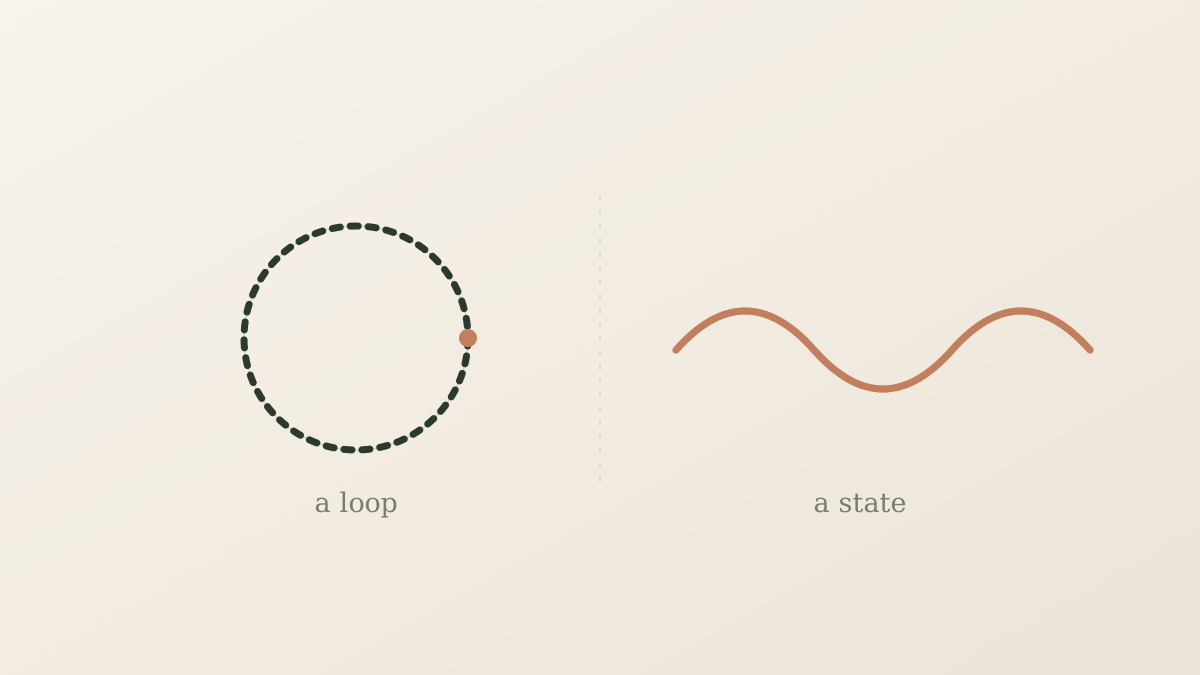
Overthinking is a pattern of thinking. Anxiety is a state. Telling them apart matters, because using the right strategy on the wrong one can cost you months.
You replay the same conversation four times before falling asleep. You draft and redraft a text that should've taken ten seconds. You know the decision you're stuck on isn't actually that big a deal, and you still can't put it down.
Is that overthinking? Or is it anxiety?
Most people use the two words interchangeably, which is fine most of the time. Language doesn't need to be clinical to be useful. But when the loop won't stop, or it starts costing you sleep or a relationship or your work, it's worth figuring out which one you're actually dealing with. They don't respond to the same things, and I've seen a lot of people spend months trying to fix one with tools meant for the other.
The short version
Overthinking is a pattern of thinking. You're going over something too many times, from too many angles, usually after the fact or right before a decision. It's exhausting, but it has a shape to it: a start, and eventually, an end.
Anxiety is more of a state. A background hum of unease or alertness that doesn't need a trigger to keep running. A lot of the time, overthinking is just something anxiety does. It's not the thing itself.
So overthinking can be a symptom of anxiety. But you can overthink without being particularly anxious, and you can be anxious without much "thinking" involved at all. Some people barely narrate their anxiety in words. It just shows up as a tight chest or a churning stomach, no story attached.
How they actually feel different
Overthinking is usually about something specific. A decision. A conversation that maybe landed wrong. Once that thing resolves (the message gets sent, the decision gets made), the loop tends to loosen, even if it takes a while.
Anxiety often isn't about anything in particular. You can wake up with it before you've had a single thought. It shows up on days that are objectively fine. It's less "I keep thinking about X" and more "something feels off and I can't say what."
There's also a physical difference worth noticing. Overthinking is mostly a head thing: did I say the wrong thing in that meeting, should I have replied differently, what if this job is a mistake. Anxiety tends to live in the body first: a tight chest, shallow breathing you only notice once someone points it out, restlessness with nowhere to go.
And here's the part that trips people up the most. Overthinking can usually be reasoned with. You talk it through, weigh the options, get someone else's take, and eventually land somewhere. Anxiety doesn't work that way. You can already know the flight is statistically safe. You can already know your friend probably isn't upset with you. Knowing doesn't turn it off, because anxiety was never really a logic problem to begin with.
Why the distinction matters
If you treat anxiety like it's overthinking, you end up trying to think your way out of something that isn't asking for more thinking, and you usually just get more of it, plus the frustration that none of it's working.
If you treat overthinking like it's anxiety, you might reach for breathing exercises or grounding techniques when what you actually need is to make the decision, get the missing information, or have the conversation you've been avoiding.
Neither is a wrong thing to try. But knowing which one you're facing can save you months of using the wrong strategy on the right problem.
A rough way to check
Ask yourself: if the specific thing resolved right now, would the unease go with it?
If getting the answer, sending the message, or making the call would genuinely quiet things down, that's probably overthinking. If the unease would still be sitting there, just looking for something new to attach to by tomorrow, that's closer to anxiety.
This isn't a diagnostic test. It's just a way to start noticing your own pattern, which is usually the first real step before anything shifts.
What tends to help
For overthinking, it helps to name the actual decision underneath the loop, out loud or on paper, since vague unease is much harder to sit with than a problem with an actual shape. A time boundary helps too: I'll give this until Sunday, then I decide with what I have. And sometimes the loop just needs a second voice to interrupt it, even someone who isn't going to solve it for you.
For anxiety, the body usually needs attention before the thoughts do. It's hard to reason with a nervous system that's still switched on. It also helps to notice whether it's constant or comes in waves, and what tends to come before it. If it's persistent or getting in the way of daily life, that's usually a sign it needs more than a single technique. It needs an ongoing, proper look at what's keeping it going, which is something worth doing with a professional rather than alone.
If this sounds familiar
Most people I work with are somewhere in between: some overthinking, some anxiety, each one feeding the other. That's normal, and you don't need to have it sorted out or diagnosed before you bring it up with someone.
When this pattern shows up specifically in a relationship, it often has a particular shape — that's covered in signs of an anxious attachment style. And if you're still weighing whether any of this is worth raising at all, that question has its own answer.
If this has been sitting with you for a while, or you're genuinely not sure which of these fits what you're going through, that's a reasonable thing to bring to a session. I work with young adults on exactly this kind of overthinking-anxiety overlap, drawing from CBT, humanistic therapy, and trauma-informed care, shaped around what you're actually bringing, not a fixed script.
Sessions run on a sliding scale (₹500–₹1000), so cost shouldn't be the reason this stays unaddressed. You can read more or book a session here.
If you're in immediate distress or having thoughts of self-harm, please reach out for emergency support: iCall 9152987821, or Vandrevala Foundation 1860-2662-345 (24/7). This post is educational and isn't a substitute for individual care.